
With earnings season over it's laying down for a nap. Would someone pull down the shades and turn off the lights, please?
Now, since it is not possible to quantitatively establish the status of the total of real goods and services, obviously various data like real income, real personal consumption expenditure, or real GDP that government statisticians generate shouldn't be taken too seriously. The data that are generated by means of mathematical methods is just a fiction.
Yet this fiction passes as the facts of reality, which allows economists to make comments with a straight face regarding the likely future direction of the real economy. The debate is often confined to the decimal point of the rate of growth. Thus it is debated whether the economy will grow by 3.1% or by 3.5%.
The fictitious data are served as a benchmark against which various economic theories are validated. Also, once it is accepted that it is "possible" to quantify the state of the real economy then one can also establish another fiction — the price level. This in turn provides the rationale for the importance of keeping the price level stable. And this in turn provides the justification that the central bank ought to navigate the economy towards the path of stable price level and stable real economic growth.
About $250 billion of China's reserves are in U.S. Treasuries. China's purchases ``put Pimco's Bill Gross to shame and contribute to low yields'' in the world's biggest economy, said Nouriel Roubini...
The press tends to hyperventilate over Gross's frequent comments about U.S. debt yields. The reason: He manages Newport Beach, California-based Pacific Investment Management Co.'s $90.6 billion Total Return Fund. Investors might be wise to pay more attention to where the really big money is: in Beijing.
Asia's currency-reserve arms race reflects two things. First, a desire to keep currencies from rising so that exports aren't hurt. Second, a determination to avoid a replay of 1997, when the region lacked ample reserves to fight speculators attacking currencies.
Costs of intermediate goods, those used in earlier stages of production, rose 1.2 percent last month and are up 9.3 percent in the 12 months ended in January. Prices of raw materials, or so- called crude goods, fell 0.5 percent and were up 23.6 percent in the last 12 months.
Faced with rising raw-material costs, manufacturers are raising prices. Caterpillar Inc., the world's largest maker of earthmoving equipment, said last month that fourth-quarter profit surged 54 percent, helped in part by higher prices. The company raised its earnings forecast for this year and announced a price increase of as much as 5 percent, effective Jan. 1.
Broad money supply (M3) rose $9.3 billion to a record $10.280 Trillion (week of Feb. 6). During the past 38 weeks, M3 has inflated $654 billion, or 9.3% annualized. Over 52 weeks, M3 has expanded 8.2%, with M3-less Money Funds up 8.3%. For the week, Currency added $0.4 billion. Demand & Checkable Deposits fell $26.4 billion. Savings Deposits jumped $24.2 billion, and Small Denominated Deposits increased $2.6 billion. Retail Money Fund deposits slipped $0.6 billion, while Institutional Money Fund deposits rose $11.0 billion. Large Denominated Deposits declined $11.0 billion. Over the past 52 weeks, Large Deposits were up $264 billion, or 23.3% annualized. For the week, Repurchase Agreements jumped $12.6 billion. Eurodollar deposits declined $3.5 billion.
Bank Credit gained $2.8 billion last week (5-wk gain of $103bn) to a record $7.591 Trillion. Over the past 52 weeks, Bank Credit has inflated $676 billion, or 9.8%. For the week, Securities Credit declined $6.1 billion. Loans & Leases were up 12.0% over the past 52 weeks, with Commercial & Industrial (C&I) Loans up 15.3%. For the week, C&I loans declined $3.6 billion, while Real Estate loans expanded $8.9 billion. Real Estate loans have expanded at a 10.9% pace over the past 20 weeks and 14.5% during the past 52 weeks. For the week, Consumer loans were about unchanged, and Securities loans increased $7.6 billion. Other loans declined $4.3 billion.
Total Commercial Paper dropped $14.5 billion last week to $1.675 Trillion. Total CP is up $25.4 billion y-t-d (7wks), while having expanded $241 billion over the past 52 weeks, or 16.8%. Last week, Financial Sector CP borrowings declined $13.5 billion to $1.537 Trillion, with a 52-week gain of $247 billion, or 19.2%. Non-financial CP declined $1.0 billion to $137.7 billion, with a 52-week decline of 4.0%.
Economists since Adam Smith have argued that competition in production serves consumers' interests, while monopolies tend toward sloth and waste. Gustave de Molinari, editor of the Journal des economistes, was probably the first legal theorist who dared to ask why this should not be as true of the law as it is of apples, cotton, and iron. He argued that under the state's monopoly of law " Justice becomes slow and costly, the police vexatious, individual liberty is no longer respected, [and] the price of security is abusively inflated and inequitably apportioned. . . ." He therefore advocated a non- monopolistic legal system and projected that once " all artificial obstacles to the free action of the natural laws that govern the economic world have disappeared, the situation of the various members of society will become the best possible."
Our analysis doesn't imply that the US economy is in healthy shape - far from it. However, what we maintain is that the key factor behind the erosion of US fundamentals is not the widening in the trade account as such, but rather the policies of the Fed. During the reign of Alan Greenspan between August 1987 and December 2005, money AMS has increased by 173%. Greenspan's strong monetary pumping was accompanied by a massive artificial lowering of interest rates. The federal funds rate was lowered from 6.5% in 2000 to 1% in 2003. Obviously then such reckless policies must have severely undermined the process of real wealth formation. However, focusing on the trade account statements only diverts the focus of attention from the true culprit behind the erosion of US economic fundamentals.

The index "will provide an essential composite look at this new market, and will provide the benchmark that investors and analysts will use as the indicator for this emerging business sector," said CBOE Chairman and CEO William Brodsky in a statement. He expects options and futures to be listed on the index soon.


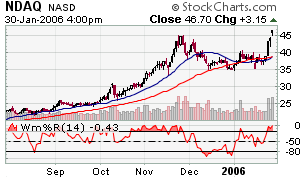

As an exercise for the students, compare and contrast the results from raising a boring quarter point now and another quarter point at the next meeting, versus a bold half point increase now and no increase at the next meeting. The following Fed meetings will show the timing value of a sharp increase in rates now. By then, the media will talk about little more than the dreaded deflation toward which our economy is surely falling, and the Fed will be able to cut rates by a half point at each of the next few meetings to protect us from the dastardly deflation fate which would otherwise crush our economy (despite the contrary evidence offered by energy and metals prices which will be setting new record highs). Those sharp rate cuts over the spring and summer, combined with the ever increasing M3 money supply which will no longer be published, will have our economy running at full speed again by late fall, and will push stock prices to record highs. Coincidentally, that will put voters in a good mood by November.
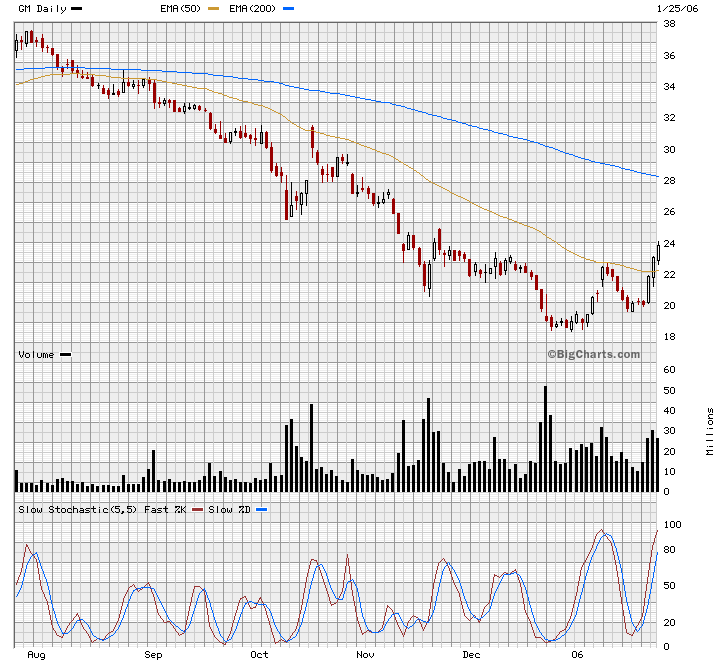
His latest move may indicate he believes GM is listening to his ideas for improving the company. In a speech to Wall Street analysts this month, Kerkorian's top aide Jerome York called on GM to cut its annual dividend in half and set profitability goals and a timetable for achieving them.
York said Kerkorian was interested in buying more GM shares and was optimistic about its recovery efforts, but he said it was time for GM to get into a "crisis mode."



Economists estimate that more that 70 per cent of the reserves are invested in US dollar assets, which has helped to sustain the recent large US deficits. If China were to stop acquiring such a large proportion of dollars with its reserves - currently accumulating at about $15bn (EU12.4bn) a month - it could put heavy downward pressure on the greenback.
However, according to Stephen Green, economist for Standard Chartered in Shanghai, although the language was "vague", Thursday's statement was the first time Safe has publicly indicated a shift away from dollar assets.
"It is a subtle but clear signal that they are interested in moving away from the US dollar into other currencies, and are interested in setting up some kind of strategic commodity fund, maybe just for oil, but maybe for other commodities," he said.
"The People's Bank of China plans to restrict growth in M2, the broadest measure of money supply, to 16 percent this year, the central bank said on its Web site, citing an annual working conference held yesterday."
``The M2 target is in line with the aim of having a healthy and stable policy,'' said Huang Yiping, Citigroup Inc.'s Hong Kong-based chief Asia economist.
``The M2 target is in line with the aim of having a healthy and stable policy,'' said Huang Yiping, Citigroup Inc.'s Hong Kong-based chief Asia economist. ``We aren't expecting any big tightening moves until inflation picks up and becomes a risk.''
China's consumer prices rose 1.3 percent from a year earlier in November, compared with a 1.2 percent gain in October. Inflation has eased from a high of 5.3 percent in July and August 2004 after the government clamped down on bank lending to industries such as steel and real estate.
The number of rate increases needed to control inflation ``probably would not be large,'' yesterday's minutes from the Fed's December policy meeting showed. The ``measured'' phrasing was retained to avoid any suggestion of bigger rate increases, the central bank said.
"...apart from inflation and economic imbalances, the defining characteristic of the Greenspan Fed has been its dishonesty. We have already seen how Greenspan claimed to have mimicked gold standard conditions. Moreover, instead of admitting how he was responsible for the tech stock bubble through the creation of moral hazard and suppression of interest rates, he blamed the bubble on "irrational exuberance." And instead of admitting his role in creating the housing bubble, he denied that there was such a bubble. Later, when he admitted that the housing bubble was real, he spoke out against it as if he had nothing to do with having created it in the first place."

