Tyler Cowen wonders why futures markets, such as the NYMEX, don't sell longer term bets, and offers up a few possible reasons why.
My take is that these markets develop and grow out of the needs of the hedgers, who look to lay off the risk of future price changes, and focus their efforts on profiting from efficient development, marketing, and production, etc., where they can play a strong hand.
For a market in longer term contracts,like 10 years out, it may not be enough that speculators want them. Speculators can come and go as they please, and their activity alone would probably not provide enough consistent liquidity to sustain the operation.
But firms whose existence requires them to be consistent buyers or sellers of a commodity, like refining and exploration companies are with oil, may have business needs which only require them to lay off price risk a few years out and not beyond.
Without the hedgers participation in the longer term contracts, there is little hope of enough liquidity to justify the contracts existence.
But over-the-counter contracts can be created by the larger brokerage houses, who will take the other side of any bet you care to make--for the right price. If enough of the same kind of OTC bet keeps getting requested, then someone there will eventually get the idea to standardize and list it.
Saturday, August 27


Inflation and Asset Prices
If someone were to ask you what the current rate of inflation is, what would you say? Well, if your answer has anything to do with the CPI (consumer price index) number, you should think again.
Thorstein Polleit writes on the problem with using this index as the benchmark.
Massaging the perceptions of their populations is the oldest game in politics. Are things really as good as they say they are?
The Austrian economists were critical of the use of all indexing, for a number of reasons, and they argued against the use of aggregates that has come to dominate the world of macroeconomics.
The misuse of the (government created) CPI is but one example of how the U.S. government tries to put off the consequences of its own monetary manipulation, at first denying the existence of inflation, and then when no one buys that line anymore, blaming someone else for causing it in the first place.
But being that the nature of all governments is some combination of force and fraud, one could expect no more from them.
The interesting part is how mainstream economists, who have some degree of independence and intelligence, will don their tu-tu's, go before the cameras, and say their lines on cue; denying domestic inflation and blaming price increases on the greedy oil companies or some other villain of the moment.
Misdirection is essential for the scheme to work.
It's how all pickpockets operate.
Thorstein Polleit writes on the problem with using this index as the benchmark.
Massaging the perceptions of their populations is the oldest game in politics. Are things really as good as they say they are?
The Austrian economists were critical of the use of all indexing, for a number of reasons, and they argued against the use of aggregates that has come to dominate the world of macroeconomics.
The misuse of the (government created) CPI is but one example of how the U.S. government tries to put off the consequences of its own monetary manipulation, at first denying the existence of inflation, and then when no one buys that line anymore, blaming someone else for causing it in the first place.
But being that the nature of all governments is some combination of force and fraud, one could expect no more from them.
The interesting part is how mainstream economists, who have some degree of independence and intelligence, will don their tu-tu's, go before the cameras, and say their lines on cue; denying domestic inflation and blaming price increases on the greedy oil companies or some other villain of the moment.
Misdirection is essential for the scheme to work.
It's how all pickpockets operate.
Friday, August 26
Planning For Failure
From cafe Hayek, an MIT professor finds the solution to high oil prices in a scheme to have the best and brightest take over the helm of the American energy market, and force it to conform to their more rational plan for production and consumption.
Dr. Heywood differs from Chinese communists--in that he is not Chinese, and he would most likely balk at the accuracy of the label "communist".
The functions and importance of the system of free prices is a pretty big thing to not know about. And it takes more than a pinch of hubris to be willing to go out in public and unflinchingly display that ignorance. But Dr. Heywood plows ahead, nonetheless.
On second thought, he's perfect for the job.
Dr. Heywood differs from Chinese communists--in that he is not Chinese, and he would most likely balk at the accuracy of the label "communist".
The functions and importance of the system of free prices is a pretty big thing to not know about. And it takes more than a pinch of hubris to be willing to go out in public and unflinchingly display that ignorance. But Dr. Heywood plows ahead, nonetheless.
On second thought, he's perfect for the job.
Saturday, August 20
You Wanna Bet?
Alex Tabarrok from the Marginal Revolution gets a chuckle over environmental "scientists" who are long on talk, short on integrity in Not Putting Their Money Where Their Mouths Are.
Inflation: Deception at the Core
Peter Schiff on Getting to the "Core" of Inflation Propaganda at Kitco.com, argues against this sleight of hand used by establishment economists and media "intellectuals".
These economists say that the already misleading inflation numbers put out by the beneficiaries of said unacknowledged inflation, need to be modified even further, to exclude those price increases which they would like not to be taken account of by ordinary Americans, who know that they, themselves, are paying much higher prices this year, but could be fooled into thinking it's just the result of their own bad luck--and not of the abhorent abuses of the hogs at the trough in our nation's capital.
They might be fooled if morons in suits say these stupid things with straight faces, resonant voices, and the steady stare of their dark, beady eyes which mask the condemned souls of these fallen ones--servants of beelzebub.
At least the people might be fooled for a little while longer. And hey, it's just the next election cycle that really counts anyway, right?
These economists say that the already misleading inflation numbers put out by the beneficiaries of said unacknowledged inflation, need to be modified even further, to exclude those price increases which they would like not to be taken account of by ordinary Americans, who know that they, themselves, are paying much higher prices this year, but could be fooled into thinking it's just the result of their own bad luck--and not of the abhorent abuses of the hogs at the trough in our nation's capital.
They might be fooled if morons in suits say these stupid things with straight faces, resonant voices, and the steady stare of their dark, beady eyes which mask the condemned souls of these fallen ones--servants of beelzebub.
At least the people might be fooled for a little while longer. And hey, it's just the next election cycle that really counts anyway, right?
Option Market Making by Allen Jan Baird

This book is written for those who would like to become a market-maker on one of the options exchange.
Baird's focus is on the "...basic risks, strategies, and tactics of options market-making as a profitable business. It's goal is to be both a theoretical and a practical reference for options traders, dealers, and market-makers in financial and commodity options markets..."
Right off the bat you know that this is not a book for beginners or small-time retail options traders. Nor is it a book for the speculator of any size for that matter, though they too would profit from reading it.
His focus is on those people who have to take the other side of whatever order may come into the options trading pit, and how they might capture their profit while still minimizing their risks.
He starts out with a brief discussion of fair value, pricing models, and volatility. Then he quickly moves on to the standard risks of individual options such as delta, gamma, vega, etc., giving good explanations of each.
Next, he talks about those subjects which don't often appear in thin books on options trading: synthetics, conversions and reversals, the importance of interest rates and boxes, time and calendar risks, and finally core strategies and market-making tactics.
Baird does a great job of avoiding the temptation to impress his readers with a lot of formulas and mathematics and instead relies on simple examples and diagrams to get his concepts across.
As I said, this is a thin volume, coming in at under two hundred pages, but it gets right to the heart of the matter. It doesn't take the encyclopedic approach that some fall back on, but gives simple and direct instructions on how to hedge individual trades and what kinds of overall positions you should be shooting for as a market maker.
This is an excellent addition to any library on options trading, as a reference for the speculator, or an instructional guide for the future market maker.
Options Market Making gets the Full Moon rating; excellent.
Friday, August 19
QQQQs in the short term; bad moon rising.
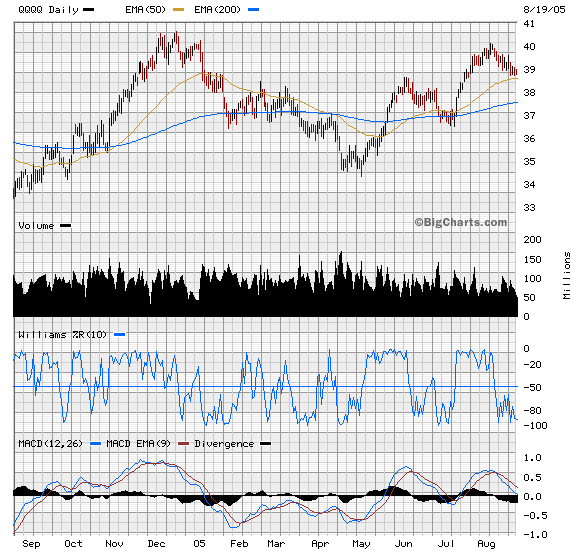
The Nasdaq, here represented by the qqqq's, looks ready to make a run up to test the yearly high near $41.
But coming at this time of year, in this interest rate environment, and during the first year after a Presidential election, The odds are...that it will fail.
The recent correction during August has been accompanied by the increase in implied volatility that one expects to see when a stock heads south (yellow line). If the Q's do rally from here, implied volatility will again decline offering up a great opportunity to the straddle or put buyer to buy cheap vol going into the traditionaly stormier seas of September.

Front month implied vol on the Q's is currently running about 14 which is not a bad buy in itself, historically, but should it get down to around 10 again within the next few weeks, it would be a screaming buy.
If one wanted to trade this scenario immediately, one could SELL the Put spread Oct 38-39 for about a $.40 credit. Then when the market tests the new highs in the next few weeks buy back the short options (the Oct 39 puts) with the lower implied vol--for about $.30, leaving you long the Oct 38 puts for a net CREDIT of $.10.
Though there aren't any sure things in trading options, getting long vega and gamma that cheaply in this market environment is a solid bet, leaving one open to the small probability of a big payoff.
Monday, July 18
Citigroup and the Business Cycle
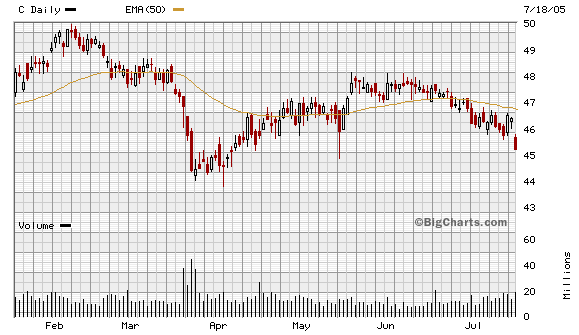
Citigroup earnings disappoint due, in part, to a flattening yield curve; it's fixed-income markets revenue dropped by 28% from the prior year. The stock is currently down about 2.5% on the day and has been the catalyst for a weak banking sector.
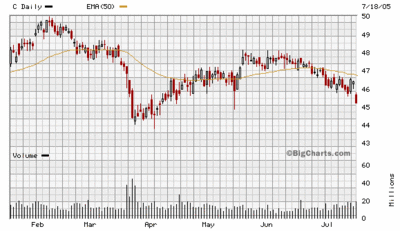
When short-term rates are high relative to long-term rates, bank margins get squeezed. Since they are in the business of borrowing "short" and lending "long", when their cost of funds rises (short rates), while the price they charge others to borrow them remains the same (long rates), their profits dissappear.
The yield curve itself is a product of both the market, and government intervention. The Fed has been hiking up short rates in order to keep inflation at bay, and to keep speculative markets like real estate, from getting out of hand. But longer-term rates like the ten year T-bond yield, are set by the market, and have remained stubbornly low.
If short rates continue to rise and surpass long rates, the yield curve will then be negative, and that does not bode well for the economy or the stock market. Financing begins to dry up as lending money becomes unprofitable, and business activity slows down as a result.
And even a well diversified banking powerhouse like Citigroup will feel the pain of an unacknowledged business cycle.
When short-term rates are high relative to long-term rates, bank margins get squeezed. Since they are in the business of borrowing "short" and lending "long", when their cost of funds rises (short rates), while the price they charge others to borrow them remains the same (long rates), their profits dissappear.
The yield curve itself is a product of both the market, and government intervention. The Fed has been hiking up short rates in order to keep inflation at bay, and to keep speculative markets like real estate, from getting out of hand. But longer-term rates like the ten year T-bond yield, are set by the market, and have remained stubbornly low.
If short rates continue to rise and surpass long rates, the yield curve will then be negative, and that does not bode well for the economy or the stock market. Financing begins to dry up as lending money becomes unprofitable, and business activity slows down as a result.
And even a well diversified banking powerhouse like Citigroup will feel the pain of an unacknowledged business cycle.
Tuesday, July 12
Single-digit Implied Volatility

Implied volatility (yellow line) on the OEX is now down below 10. It generally goes lower as the market moves up, and higher when prices move down.
But at this low level the daily drip of decay is more bearable to option-buyers as they wait for the next big move.
The Treasury Bond real interest rate
An interesting look at the current bond market interest rate conundrum throught the lens of Austrian Economic theory, via Mises.com.
The problem is that the current real interest rate is roughly zero, the exact number being dependent upon how you arrive at the true rate of inflation, and therefore, what you think it is; government supplied numbers are never quite what they seem.
If the current nominal market rates are the result of an artificial stimulation by the central bank, then the coordination between the time-preferences of savers, and the time-preferences of borrowers will be all screwed up, leading to further boom/bust cycles in the economy and a genuine loss of wealth.
The problem is that the current real interest rate is roughly zero, the exact number being dependent upon how you arrive at the true rate of inflation, and therefore, what you think it is; government supplied numbers are never quite what they seem.
If the current nominal market rates are the result of an artificial stimulation by the central bank, then the coordination between the time-preferences of savers, and the time-preferences of borrowers will be all screwed up, leading to further boom/bust cycles in the economy and a genuine loss of wealth.
Tuesday, July 5
QQQQ and the Moody Blue
 The big picture on the Nasdaq composite eqivalent, QQQQ's.
Resistance can be found at the high of $40 from the end of last year, where the 200 month moving average is also coming to rest. Notice the distribution volume during the first half of this year.
Now tell yourself it will all be O.K.
Saturday, July 2
Money Supply heading South of the border
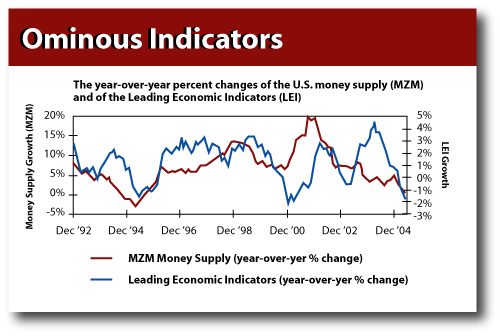 This graph from an article over at The Daily Reckoning gets to the heart of the matter. The stock market is in for a heap of trouble this fall given this kind of monetary environment. MZM has gone negative and the yield curve is flattening, and may go negative as well.
This adds up to a recession for the economy and a downtrend for the stock market, with the possibility of a good old fashioned whacking before the end of the year. The August-September time period is the most likely candidate for the lows of the year, according to The Stock Trader's Almanac put out by Yale Hirsch, and the year after a Presidential election tends to be the worst.
If this is true what should you do? If you've already made some money this year on a good pick or two, think seriously about banking it, or at least hedging. If you want to make some money on the possible down turn, buy some puts.
Implied vols, which means options prices, are low at this point, i.e., calls and puts are cheap. This varies from stock to stock of course but as an example, let's take a look at the QQQQ options:
 As you can see, the implied volatility (yellow line) of the Q options is at a low. Notice how it spiked up in August of last year, which is another way of saying that the calls and puts suddenly became a lot more expensive, or that those who had the foresight to buy them just prior, made a lot of money. Will this August be the same?
Of course no one can predict the future, but those who consistently make money at anything know to place their bets when the odds are in their favor, and reduce their risk when the odds are against them.
Saturday, June 25
Credit Spreads
SFO has a good article on one of my favorite options strategies. The best thing about it, is the fact that with credit spreads, time is on your side.
But the downside is that right now in the equities options markets, implied vols are low. People have already been selling those at-the-moneys for all they're worth, and you may just be the last in line. Your wages (pay per hour) would be very low at this point, so why bother?
Then again, if the skew was in your favor, you could probably find a good backspread or two and just wait it out. Sometimes even negative surprises can be a good thing.
But the downside is that right now in the equities options markets, implied vols are low. People have already been selling those at-the-moneys for all they're worth, and you may just be the last in line. Your wages (pay per hour) would be very low at this point, so why bother?
Then again, if the skew was in your favor, you could probably find a good backspread or two and just wait it out. Sometimes even negative surprises can be a good thing.
Charting the Volatility Index

Successive hundred point drops in the DOW due to higher oil prices, caused a rise in the VIX from it's low of around 11; straddle buyers should be happy.
When she bottoms, she bottoms quickly. People get nervous before earnings season and in this environment of higher short rates and higher commodity prices, they may not want to risk a nasty surprise. So some will sell early and come back to buy after the dust settles.
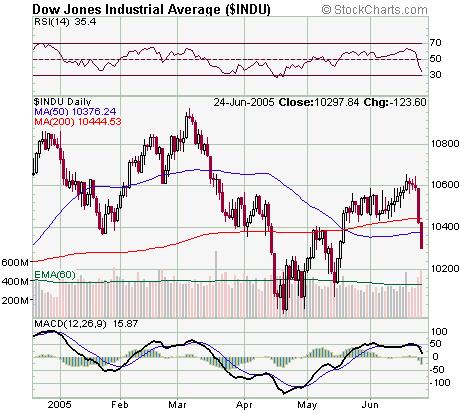
Maybe the Summer will be interesting after all. The down days came on heavier volume in the DOW and left a lower high behind, hinting at an intermediate term downtrend in the stock market.
But in order to make that official, the DOW would have to drop below the 10,000 mark, making a lower low; not an easy thing to do without a small dose of panic.
And that's something the straddle buyer would love.
Thursday, June 23
Black Robes and Goose Steps
The long march continues, as the Leftists on the "Supreme" Court lead us further down that glorious road to serfdom.
"Taking" is a tradition here in the land of the free; the very foundation of progress. Without it, how could we plan for our glorious future? Should chaos rule, instead?
Your house is your's--unless we want it. Then it's ours... so it can then become his. Let the will of " the people" be done.
And let this blather about your rights, be done, too. You stand in the way of progress, waving some old parchment that's of no interest to us. You will be crushed, and your parchment will be buried, and we will drown your cries with the sounds of our boots, clapping the ground as we march on past.
Your quaint attachment to this notion of rights, is outdated in this era of public-spiritedness and planning. Our rulers are benevolent, and much smarter than you. And only by their will, can some progress appear. Let their will be done.
On what basis do you challenge them? You are a selfish peasant who seeks to deprive the community of what it needs. When instead you should be rejoicing for the opportunity to serve. No more evidence of your individual corruption is necessary. By your challenge, you display your guilt.
The people march forward in stone-faced columns, with empty hands and hollow eyes. Following the goose-stepping imposters in their shining, black robes.
With nothing in particular on their minds.
"Taking" is a tradition here in the land of the free; the very foundation of progress. Without it, how could we plan for our glorious future? Should chaos rule, instead?
Your house is your's--unless we want it. Then it's ours... so it can then become his. Let the will of " the people" be done.
And let this blather about your rights, be done, too. You stand in the way of progress, waving some old parchment that's of no interest to us. You will be crushed, and your parchment will be buried, and we will drown your cries with the sounds of our boots, clapping the ground as we march on past.
Your quaint attachment to this notion of rights, is outdated in this era of public-spiritedness and planning. Our rulers are benevolent, and much smarter than you. And only by their will, can some progress appear. Let their will be done.
On what basis do you challenge them? You are a selfish peasant who seeks to deprive the community of what it needs. When instead you should be rejoicing for the opportunity to serve. No more evidence of your individual corruption is necessary. By your challenge, you display your guilt.
The people march forward in stone-faced columns, with empty hands and hollow eyes. Following the goose-stepping imposters in their shining, black robes.
With nothing in particular on their minds.
volatility crush
Summer's here for the options markets; volatility is nearly nonexistent as the VIX sinks to 11. This means both calls and puts are being sold by the professionals, who don't expect much activity in the stock market--at least not for the next 30 days.
Are they right? Probably yes, for now. But at some point nearer to the end of Summer, in this post-election year, shopping for puts will be the prudent thing to do. Especially if options prices remain this low. Short term money is getting tighter now, by the Fed's design. They pumped enough into the system prior to the election to keep the incumbents happy, and now it's time to soak it back up. Same old story.
With commodity prices continuing to move up putting the squeeze on margins, the third quarter results could have an excellent chance of coming up short. And surprises are very good for options buyers.
Are they right? Probably yes, for now. But at some point nearer to the end of Summer, in this post-election year, shopping for puts will be the prudent thing to do. Especially if options prices remain this low. Short term money is getting tighter now, by the Fed's design. They pumped enough into the system prior to the election to keep the incumbents happy, and now it's time to soak it back up. Same old story.
With commodity prices continuing to move up putting the squeeze on margins, the third quarter results could have an excellent chance of coming up short. And surprises are very good for options buyers.
Tuesday, June 21
Subscribe to:
Posts (Atom)