Thursday, January 12
Quick Charts; Oil and Exchanges
Here are a few good oil related stocks and exchange and trading related stocks. We'll need them in the future.


Wednesday, January 11
CMED Out

Just as I thought, the stock tried to punch through the $40 mark, as you can see on this intraday chart, but failed and closed down.
Fortunately we had a $5.80 offer out on the Jan 35 calls which got taken out on the stock's run up, and we then closed out the other part of our vertical, the short Jan 40 calls, to close.
Bought for $1.50, sold for $3.60.
$210 profit per spread on the initial $150 investment.
CMED, Legging out
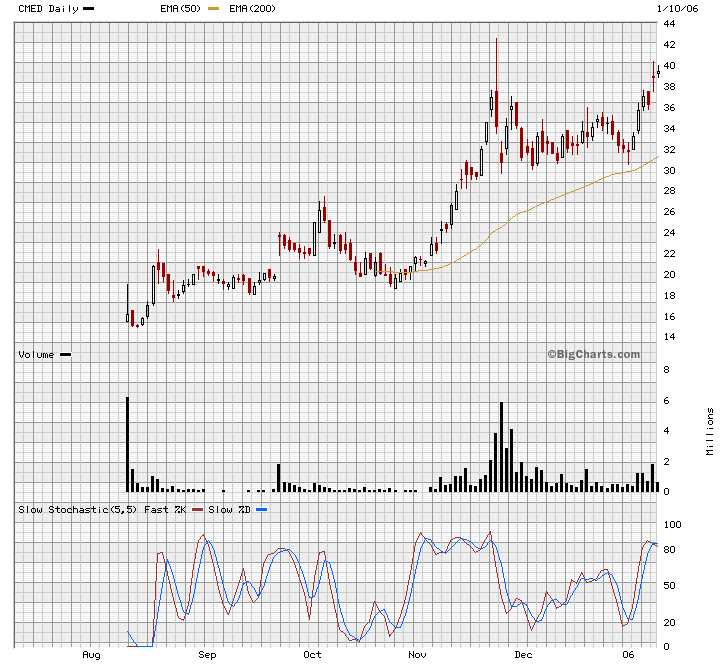
We paid $1.50 for the CMED Jan 35-40 call spread--buying the Jan 35 calls and selling the Jan 40 calls--and since the stock has met our expectations we are looking to get out as the stock hits a ceiling at $40.
But CMED presents a problem common to stocks with illiquid options markets; the bid-ask spread is wide and we don't want to give that much money away.
On tuesday the stock closed at $39.41, and the Jan 35 calls, the part of our spread that we are long, was $4.60 bid, at $5.40--$.80 wide. Too wide.
We'll put out an offer to sell this Jan 35 call at $5.80 and see what happens. Why?
If the rest of the market is neutral we can bet that CMED will make another attempt at crossing above $40, even if it does not close above it. When it does make the run, those Jan 35 calls, which are deep in the money, will move up almost as much as the stock itself.
So if the stock moves up the required $.60 to hit the $40 mark, the calls should move up, let's say $.50. The $5.40 offer on the exchanges will rise to $5.90 uncovering our offer at $5.80--and we will become the best one; the next to sell to those momentum call buyers.
Even if the professionals keep lowering their offer to remain the best one, the stock may continue to rise and they will be forced to fade and maybe buy our call themselves in order to get us out of their hair.
Once we sell the 35 call we can pay the offer on the Jan 40 call or work out of it, and we will be out of the spread.
In the real world you can react to the market in real time, but it is always good to go into the trading day with a plan. As old Gomp used to say "ya've gotta have a plan". Of course that always included a sixer of King Cobra...
Saturday, January 7
STJ Missed
Do you like apples?
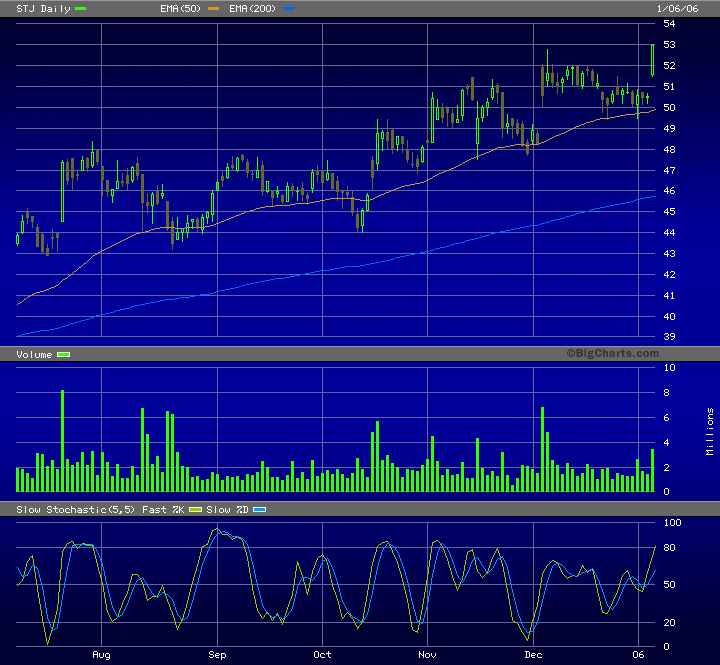
Well I turned around and wasn't paying attention to STJ for a few days while it came back in to $50 and support at its 50-day moving average and so I missed my chance to sell the Feb 50-55 put spread for fat cash how do you like them apples?
AAPL Trade

AAPL Jan 75-80 put spread let's hypothetically sell it at a $3.20 limit. If the stock comes in closer to $75 during the day (mon.) it might get taken. The stock should find support @ $75 after it broke through and closed above resistance there.
As we've noted before, vertical spreads have a limited profit and a limited loss. To sell a Jan 75-80 put spread, you have to sell a Jan 80 put and buy a Jan 75 put. The difference between the two prices is what the spread trades for, if we sell it, someone else buys it.
Then net amount of money goes into our trading account and sits there until we close out the trade by buying the same spread back. Hopefully for a lot less than we sell it for if our offer gets taken.
Stay tuned...
Friday, January 6
China Shifting Away from the Dollar?
If so, the dollar gets weak and long term bond yields rise.
Goods imported to the U.S. will themselves become more expensive, and will no longer have as much of a dampening effect on domestic prices here, paving the way for a "surprising" uptick in future CPI numbers, including the phony "core" rate of inflation.
And their appetite for commodities from around the world will continue to grow. Thanks to prudentbear.com for the pointer.
Economists estimate that more that 70 per cent of the reserves are invested in US dollar assets, which has helped to sustain the recent large US deficits. If China were to stop acquiring such a large proportion of dollars with its reserves - currently accumulating at about $15bn (EU12.4bn) a month - it could put heavy downward pressure on the greenback.
Goods imported to the U.S. will themselves become more expensive, and will no longer have as much of a dampening effect on domestic prices here, paving the way for a "surprising" uptick in future CPI numbers, including the phony "core" rate of inflation.
However, according to Stephen Green, economist for Standard Chartered in Shanghai, although the language was "vague", Thursday's statement was the first time Safe has publicly indicated a shift away from dollar assets.
"It is a subtle but clear signal that they are interested in moving away from the US dollar into other currencies, and are interested in setting up some kind of strategic commodity fund, maybe just for oil, but maybe for other commodities," he said.
And their appetite for commodities from around the world will continue to grow. Thanks to prudentbear.com for the pointer.
Thursday, January 5
Under the Skin, All Central Banks are Alike
On the Prudence of China's central bank, again from Bloomberg.com:
And Citigroup's best chimes in...
He makes it sound so easy...
It will be fun to watch all of this unfold.
"The People's Bank of China plans to restrict growth in M2, the broadest measure of money supply, to 16 percent this year, the central bank said on its Web site, citing an annual working conference held yesterday."
And Citigroup's best chimes in...
``The M2 target is in line with the aim of having a healthy and stable policy,'' said Huang Yiping, Citigroup Inc.'s Hong Kong-based chief Asia economist.
He makes it sound so easy...
``The M2 target is in line with the aim of having a healthy and stable policy,'' said Huang Yiping, Citigroup Inc.'s Hong Kong-based chief Asia economist. ``We aren't expecting any big tightening moves until inflation picks up and becomes a risk.''
China's consumer prices rose 1.3 percent from a year earlier in November, compared with a 1.2 percent gain in October. Inflation has eased from a high of 5.3 percent in July and August 2004 after the government clamped down on bank lending to industries such as steel and real estate.
It will be fun to watch all of this unfold.
No Inflation Here
"Inflation? What inflation? Didn't we tell you the core CPI was low--nothin' you needed to worry about?"
Yeah, sure.
Another piece by Bloomberg (Commodities rise to Record...) in the growing body of evidence, that in spite of the 13 headline-capturing rate hikes by the Fed, it has actually been a prolonged period of easy money.
The core rate of inflation is only two percent, you say? Man, you are well trained!
From a story over at the Financial Times (FT.com), metals prices continue to surge.
More to follow...
Yeah, sure.
Another piece by Bloomberg (Commodities rise to Record...) in the growing body of evidence, that in spite of the 13 headline-capturing rate hikes by the Fed, it has actually been a prolonged period of easy money.
The core rate of inflation is only two percent, you say? Man, you are well trained!
From a story over at the Financial Times (FT.com), metals prices continue to surge.
More to follow...
Wednesday, January 4
AAPL, Bite It?
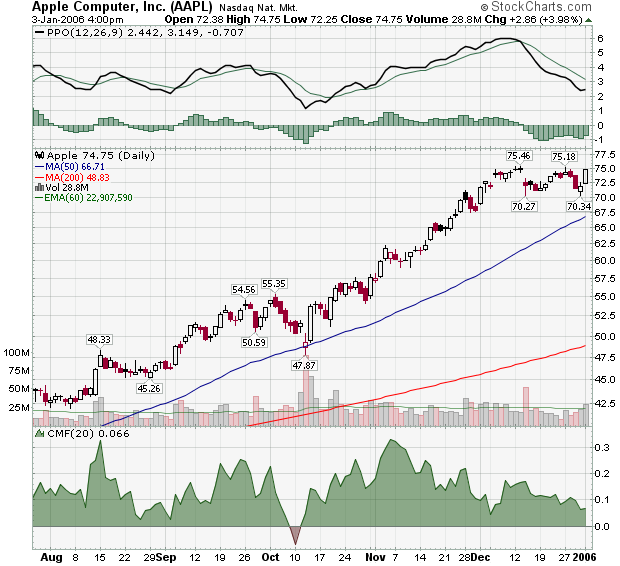
While it's better to wait until a stock is trading near it's 50 day MA and basing for six to eight weeks, watch AAPL if it closes above $75 on strong volume. You may get paid off for taking a bite.
Go East Young Man
Think the U.S. is the leading growth market for retail equity derivatives? Think again. Think kimchi and...well, read on at FT.com.
Is the Alleged Tight-Money policy Over?
From Bloomberg:
No wonder they want to get rid of M3, managing 'inflationary expectations' is half the fun of it.
The number of rate increases needed to control inflation ``probably would not be large,'' yesterday's minutes from the Fed's December policy meeting showed. The ``measured'' phrasing was retained to avoid any suggestion of bigger rate increases, the central bank said.
No wonder they want to get rid of M3, managing 'inflationary expectations' is half the fun of it.
Wednesday, December 28
Market in the Rear View: Looking Forward
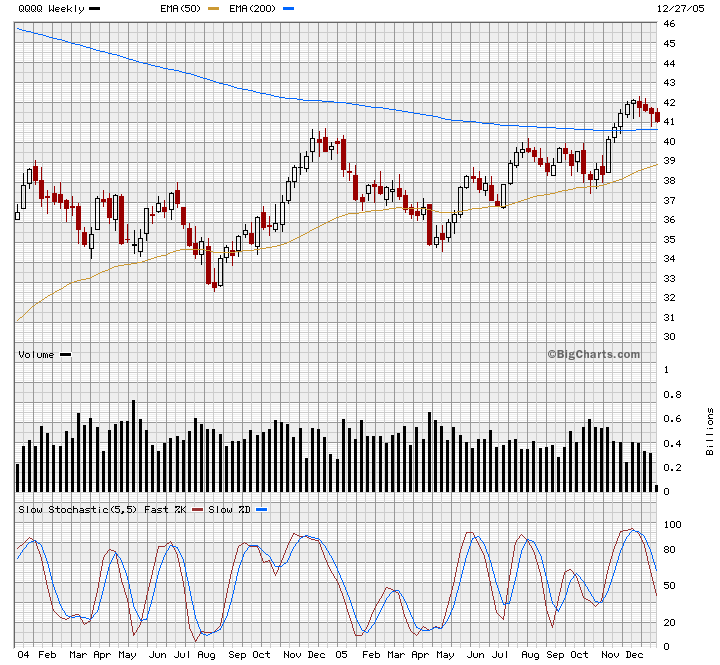
Using the qqqq as a proxy for the stock market, here is a two-year weekly chart showing the nasty fall the market took at the beginning of last year; dropping about 1/8th of its value in the first three months of the year and then using the Spring and the Fall to recover.
$40 has been the key level during this period for the q's, providing resistance to the upside, and will also provide support, when the stock starts to break lower.
This last end-of-the-year rally has been low on volume, and looks to be running out of steam. The return to the $40 level for a test will not be far off.
Short rates have risen and may continue to do so as the Fed attempts to fight the very real threat of rising prices, i.e. "domestic dollar devaluation"; a problem which was created, of course, by the Fed itself.
The yield curve has inverted, increasing the odds of a recession next year. An inverted yield curve simply means that it no longer pays banks and other financial institutions to do what they do: borrow short term money to lend it long term. It's selling something for less than you buy it for, over and over again.
When lending is unprofitable, the boss hits you over the head and tells you to knock it off. So all sorts of productive activity doesn't get financed and that means it doesn't happen. Business slows. Bubbles burst. people feel poorer.
What could prevent a recession from happening next year?
The always easiest answer is that the Fed could return to her old ways and start pumping it out again like the drunken prom queen she is. Stop kidding us honey, you know you love it!
Another very real possibility is that some kind of tax reduction legislation gets pushed through sparking another growth cycle with an unexpectedly big market upside.
The establishment fears deflation like a liberal fears virginity; odds are, they'll do whatever it takes...
Tuesday, December 27
Greenspan: The Trailer...
Stefan M.I. Karlsson, like Murray Rothbard before him, isn't pulling any punches when it comes to Alan Greenspan and his legacy.
"...apart from inflation and economic imbalances, the defining characteristic of the Greenspan Fed has been its dishonesty. We have already seen how Greenspan claimed to have mimicked gold standard conditions. Moreover, instead of admitting how he was responsible for the tech stock bubble through the creation of moral hazard and suppression of interest rates, he blamed the bubble on "irrational exuberance." And instead of admitting his role in creating the housing bubble, he denied that there was such a bubble. Later, when he admitted that the housing bubble was real, he spoke out against it as if he had nothing to do with having created it in the first place."
Wednesday, December 21
A Low Inflation Kind of Year?
The Labor Department tells us that we actually experienced Deflation in November--consumer prices dropped by 0.6%.
Bill Fleckenstein is approriately skeptical about the accuracy of the official "inflation" numbers put out by our public servants in Washington, D.C.
Bill Fleckenstein is approriately skeptical about the accuracy of the official "inflation" numbers put out by our public servants in Washington, D.C.
Sunday, December 18
Fed Abandons M3: what's up with that?
John Williams, at prudentbear.com, has some suspicions about the central bank's ending its publication of the broad monetary aggregate M3. What are they trying to hide?
Sean Corrigan over at the Mises.org blog takes an even bigger swing at it, foreseeing dire straits for the dollar and consequently much higher rates for the long bond.
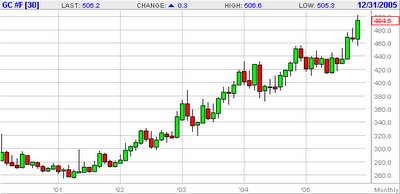
On a separate note, here's a monthly 5 year chart of the anti-dollar, i.e., gold:
Sean Corrigan over at the Mises.org blog takes an even bigger swing at it, foreseeing dire straits for the dollar and consequently much higher rates for the long bond.
On a separate note, here's a monthly 5 year chart of the anti-dollar, i.e., gold:

Saturday, December 17
Review: St. Jude Medical

STJ gave us a freebie, so we might as well take it and run.
We sold the Jan 45-50 put spread at $2.75 when the stock was trading at $47.75; now that the stock has gapped up quickly over the $50 mark up to $51.75 The put spread is $.70 bid, at $.85.
We'll buy it back for $.80 and we are out of the trade with a $1.95 profit ($195 per put spread).
We'll wait for the stock to come in again before taking on a new position. Volume is still way positive and the uptrend should continue. Watch for support at the 200 day MA.
Stock: China Medical Tech

CMED looks like it is resting before a strong move in one direction or the other. In the month of December the stock has quieted down and has found support above its 50 day moving average. But when it does move, will it be to the upside or downside?
The big reversal day in late November showed active sellers overwhelming the momentum buyers and bringing the stock price down to a more moderate rate of increase. But the uptrend is unbroken and a pullback was due. Now that the expectations for easy money have been diluted, the volume patterns show the stock is still being accumulated.
CMED is also listed in IBD's "New Buys of Top Performing Stock Funds" for November, meaning that some smart institutional money is buying it.
Furthermore, at least through the end of the year, we are in a very positive period for the stock market and so we ought not to bet against the upside.
I know what you're thinking: "let's get long the Jan 35-40 call spread for about $1.50 and see what happens".
Okay, good call. You're getting better at this.
Monday, December 5
Stock Watch: INGR

This is another strong stock with high Investors Business Daily ratings. It's uptrend continues with its current consolidation. Institutions would rather not buy a stock too far away from its fifty day MA so they often refrain from their planned accumulation when the stocks price gets too far away.
Now the stocks historical volatility has come in from 28 down to 18 but the implied vol in the options market is still up around 26.
Since we think the stock is going up and vol is high, we need to get long by selling premium. The preferred method is selling put spreads, rather than naked puts which leave us open to big losses.
The INGR Jan 45-50 put vertical is fair at 1.90--selling the Jan 50 put @ 2.40 and buyin the Jan 45 put for .50.
Let's sell the spread there and watch.
Monday, November 14
Example: Selling an STJ Put Spread
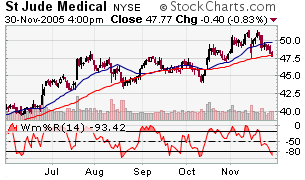
St. Jude Medical is a company with strong fundamentals in a solid group, and it has every reason to be in an uptrend. It formed an eight week base starting in August and broke above the buy point of 47 1/2 mid Oct. and up to 52, where it sold off and has returned to the 200 day moving average holding at 47 1/2. So how should you bet it?
Since the stock is still in an intermediate uptrend we look for a time and place to get long. The safest place is at the support of its long term averages when the stochastics are low and turn up, in this case when the williams% drops below -80, then heads back above it.
One way to make a bet that this stock will go higher from here is to SELL a put spread.
When the stock goes higher, the put spread will get cheaper. You can then buy it back at the lower price; or even better if the stock has moved high enough, let the price of the put spread go to zero at expiration and just pocket the money from the original sale.
The best thing about vertical spreads is that your losses are limited.
If you use strikes that are 5 points wide, like the STJ 45-50 put spread, its value will always be between $0 and $5. If you bought it for $1, the most you could lose would be $1; if you sold it for $1, the most you could lose is $4.
So let's look at the STJ Jan 45-50 put spread. With the stock at about $47.75, this put spread is trading for 2.75, or $275 apiece. Selling it there would put $275 into your acount now and if STJ went over $50 and stayed above it at the Jan expiration of those options, you would simply keep the money.
If STJ went below $45 and stayed there at the Jan expiration, you would lose the $275 plus another $225 of you own cash because the price of the put spread that you sold for 2.75, would go to 5. But you can buy it back at any time before expiration to get out of the trade, either to capture a profit or to keep from losing more.
Now with STJ in an uptrend and the stochastics about to turn up, let's paper trade the put spread, selling one at 2.75.
We'll watch it and update in the near future.
Sunday, November 13
Recent New High in the Q's

Here is the weekly chart of the Q's. A new high, yes, but where is the volume? over the last dozen weeks the volume was on the downside and now in the new rally the up weeks are tainted with modest trading activity.
Buying activity did pick up underneath the 50 day moving average, giving support there, but so far aggressive buying has been absent. If this is the start of the rally season, shouldn't there be more people in attendance? Hmm.
Okay, I'll keep a wait and see attitude. But the Fed rate hikes do continue, and this is the first year of the Presidency, classically the poorest performing of the four year Presidential cycle as the Fed tends to pull the punchbowl away after their election year manipulations have done their trick.
But rally time is rally time, and the market is showing better and broader leadership this time around.
The rotation has been out of the oil and housing stocks and into certain retail, financial, medical and transport stocks. More to come on the individual winners in the near future; stay tuned.
Friday, November 11
Real Estate Futures to Trade at the CME
Set to debut in April at the CME, this futures contract will be "based on the median home price in ten U.S. cities".
The exchanges are continuing to offer new products in an effort to compete with newcomers for order flow. Some have gone public already, and more will surely follow. Let's go to the charts to see how they're doing.
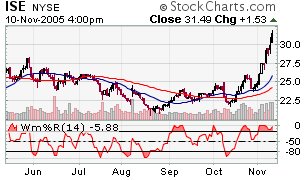
The ISE is an all electronic options exchange here in the U.S. in competition with the five others, four of which are floor-based. It has run up about 30% in the last month, and is at risk of a little correction as those holding paper profits might be quick to take some off the table. But the volume shows big accumulation and the stock is a great bet for the long haul. A good buy around $27 1/2 if it comes in.
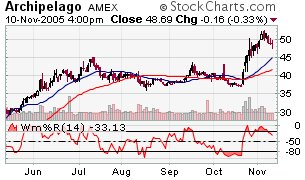
The Arca exchange has already started to come in after a quick runup from $40 on strong volume. As long as it continues to act well, it would be a great buy at $45, at the 50 day moving average.
The small group of publicly traded exchanges, which includes BOT, NDAQ and of course the CME, will continue to innovate and grow as public firms. They should be considered for the trading vehicles that they are, and also as good investments.
The exchanges are continuing to offer new products in an effort to compete with newcomers for order flow. Some have gone public already, and more will surely follow. Let's go to the charts to see how they're doing.

The ISE is an all electronic options exchange here in the U.S. in competition with the five others, four of which are floor-based. It has run up about 30% in the last month, and is at risk of a little correction as those holding paper profits might be quick to take some off the table. But the volume shows big accumulation and the stock is a great bet for the long haul. A good buy around $27 1/2 if it comes in.
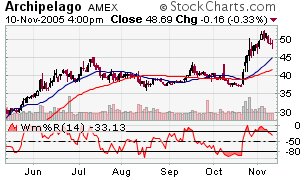
The Arca exchange has already started to come in after a quick runup from $40 on strong volume. As long as it continues to act well, it would be a great buy at $45, at the 50 day moving average.
The small group of publicly traded exchanges, which includes BOT, NDAQ and of course the CME, will continue to innovate and grow as public firms. They should be considered for the trading vehicles that they are, and also as good investments.
Thursday, November 10
Big Cap Stocks of the Week
Here are the charts of the highest rated big caps according to Investors Business Daily, based on their proprietary composite ratings.
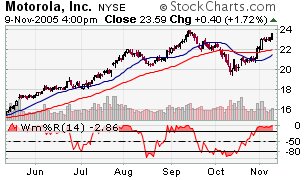
Motorola looks great with strong volume on the up days, a convincing break above its 200 day moving average, and a methodical base building process as it approaches the break out point at $24. It would be best if it had one more shake out to form a handle, before the big volume break out to new highs.
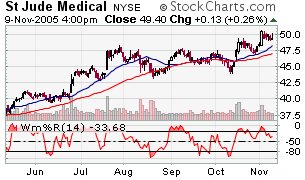
St. Jude Medical is also in an orderly uptrend, with the big volume days on the upside. It is one of the leading stocks in the strong medical sector and is showing good action after its break out at $47 1/2. A break above $50 with the continued support of its 50 day average could leave this stock a longer-term winner.
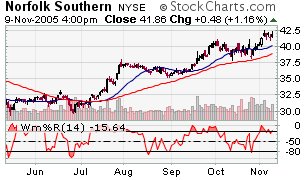
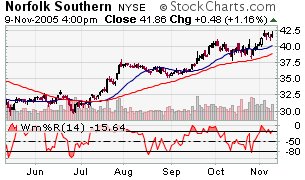
Norfolk Southern is in the very strong transports sector, has broken above a short-term base at $41, and shows the signs of volume accumulation and support in the moving averages.
The big caps tend to be less volatile, have a lot of liquidity, and have very active options markets behind them, leaving many ways to gain from their movements.
Now go forth and prosper.

Motorola looks great with strong volume on the up days, a convincing break above its 200 day moving average, and a methodical base building process as it approaches the break out point at $24. It would be best if it had one more shake out to form a handle, before the big volume break out to new highs.

St. Jude Medical is also in an orderly uptrend, with the big volume days on the upside. It is one of the leading stocks in the strong medical sector and is showing good action after its break out at $47 1/2. A break above $50 with the continued support of its 50 day average could leave this stock a longer-term winner.
Norfolk Southern is in the very strong transports sector, has broken above a short-term base at $41, and shows the signs of volume accumulation and support in the moving averages.
The big caps tend to be less volatile, have a lot of liquidity, and have very active options markets behind them, leaving many ways to gain from their movements.
Now go forth and prosper.
Wednesday, November 9
Broad Market Indexes
Here are the latest 6 month charts for a quick look at the state of the stock market.
Notice the recent run up in the Dow Transports and the flatline of the utilities during the Bull of the last few weeks. What does that tell you about the markets expectations for interest rates?
Utilities are one of the most rate sensitive sectors of the stock market. They don't do well when interest rates rise because their earnings are strongly affected by the cost of borrowing money; they are heavy debtors. When that cost is low, their earnings are high, when that cost is high their earnings are low.
Transports are strong when the economy is running strong or soon will be. Their earnings rise as they are booked to ship more goods to and from manufacturers and to their final destinations; the Dow transports are indicating an uptick in the economy which leads to a greater demand for credit, and higher rates as a result.
During the past year, businesses were getting squeezed between higher commodities prices which they pay to produce goods and services, and an inability to pass them on in the form of retail price increases.
Now however, the lid may be coming off the prices that they are able to charge, and they are anticipating larger profits in the near future as a result.
Given all this and the fact that the ten-year Treasury yield has gone from 4.0% to over 4.6% in short order, it looks like long rates will be rising with short rates, and the yield curve will continue to steepen.
But will it last if the Fed keeps raising rates?
At least for a little while, yes.
Notice the recent run up in the Dow Transports and the flatline of the utilities during the Bull of the last few weeks. What does that tell you about the markets expectations for interest rates?
Utilities are one of the most rate sensitive sectors of the stock market. They don't do well when interest rates rise because their earnings are strongly affected by the cost of borrowing money; they are heavy debtors. When that cost is low, their earnings are high, when that cost is high their earnings are low.
Transports are strong when the economy is running strong or soon will be. Their earnings rise as they are booked to ship more goods to and from manufacturers and to their final destinations; the Dow transports are indicating an uptick in the economy which leads to a greater demand for credit, and higher rates as a result.
During the past year, businesses were getting squeezed between higher commodities prices which they pay to produce goods and services, and an inability to pass them on in the form of retail price increases.
Now however, the lid may be coming off the prices that they are able to charge, and they are anticipating larger profits in the near future as a result.
Given all this and the fact that the ten-year Treasury yield has gone from 4.0% to over 4.6% in short order, it looks like long rates will be rising with short rates, and the yield curve will continue to steepen.
But will it last if the Fed keeps raising rates?
At least for a little while, yes.
Thursday, November 3
Bonds and Futures Links
A couple of more links, then I'll get back to business.
Here is a bond yield summary from BondsOnline.com; and a very concise futures page from Barchart.com.
Thanks to PrudentBear.com for both.
Here is a bond yield summary from BondsOnline.com; and a very concise futures page from Barchart.com.
Thanks to PrudentBear.com for both.
Saturday, October 29
Friday, October 28
Investors Business Daily Big Cap Twenty Stocks
Here are the graphs for Tuesday, October 25. IBD runs a computer generated ranking of leading large cap companies trading in the U.S. and I dropped them into a stockcharts.com page.
Friday, October 7
Fed's Fisher spooks the Market
He seems to be blaming a new bout of inflation on hurricane Katrina; so rates (fed funds) will continue to rise. The stock market cries 'Uncle'.
Hello seasonal bout of weakness.
Hello seasonal bout of weakness.
The End of the Dollar Standard?
Rob Lee at Prudentbear.com gives us four reasons why the U.S. dollar standard system is breaking down.
'As Voltaire said in 1729 "paper money eventually goes down to its intrinsic value – zero."'
'As Voltaire said in 1729 "paper money eventually goes down to its intrinsic value – zero."'
Tuesday, October 4
Dow Jones Industrial watch, CAT
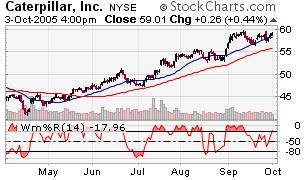
CAT, another of the big Dow 30, is coiling like a snake, ready to break out over $60 on strong volume, just like she did at $55. Get ready to sell that put spread but don't jump the gun; this little triangle pattern could still fail. Wait for the closing new high.
Subscribe to:
Posts (Atom)